
Botox vs Fillers: Benefits, Results, Costs & Which One is Right Treatment

Key Takeaways
- Quick Verdict: Choose Botox to soften expression lines that move with your face. Choose fillers to restore volume that’s already been lost.
- Ideal Candidate: Forehead lines, crow’s feet, hollow cheeks, thin lips, or that generic “tired” look regardless of sleep.
- Timeline: Botox: visible in 3–7 days, lasts 3–4 months. Fillers: visible immediately, lasts 6–18 months (up to 2 years for some cheek fillers).
- Provider Note: Most patients benefit from a personalized combination, not an either-or choice.
Botox and dermal fillers at Serenity Medical Aesthetics in Pasadena, CA, are the two most requested non-surgical treatments for facial aging, and each solves a different problem. Botox relaxes the muscles behind expression lines, with most patients seeing softening within 3 – 7 days and results lasting 3 – 4 months. Hyaluronic acid fillers such as Juvéderm® and Restylane® restore lost volume immediately, with results typically lasting 6 – 18 months depending on the product and treatment area.
Quick Answers for Botox vs. Fillers Questions
| Botox vs. Fillers Queries | Answers |
|---|---|
| What Botox treats? | Expression lines: forehead, crow’s feet, frown lines |
| What fillers treat? | Volume loss: cheeks, lips, under eyes, nasolabial folds, jawline, marionette lines |
| Results timeline? | Botox: 3 – 7 days; full effect by day 14. Fillers: Immediate; refines over 1–2 weeks as swelling resolves. |
| How long do they last? | Botox: 3 – 4 months. Fillers: 6 – 18 months |
| Booking at Serenity? | Available. Book Now! |
So, What’s the Difference Between Botox and Fillers?
People throw these two words around like synonyms. They’re not even close.
Botulinum toxin, aka Botox, is a neuromodulator. It blocks the nerve signal that tells a muscle to fire, so the muscle stops contracting as hard and the skin above it quits creasing. Forehead lines. Those two vertical elevens between your brows. Crow’s feet. All three exist because a muscle moves thousands of times a day, every single day, for decades. Freeze the muscle a little, soften the line. That’s it. No mystery.
Fillers solve a completely different problem. They’re gel, usually hyaluronic acid, placed directly into tissue to physically add back volume you’ve lost. No muscle involved at all. Structure, restored. That’s it.
Here’s where most people get tripped up. A face that looks “off” is often fighting both battles at once, movement lines up top, volume loss lower down. Fix only one, and you can end up looking like you did something without looking like yourself. That’s the worst outcome in this whole category, honestly. Worse than looking untreated.
What Does Botox Fix, and What It Doesn’t?
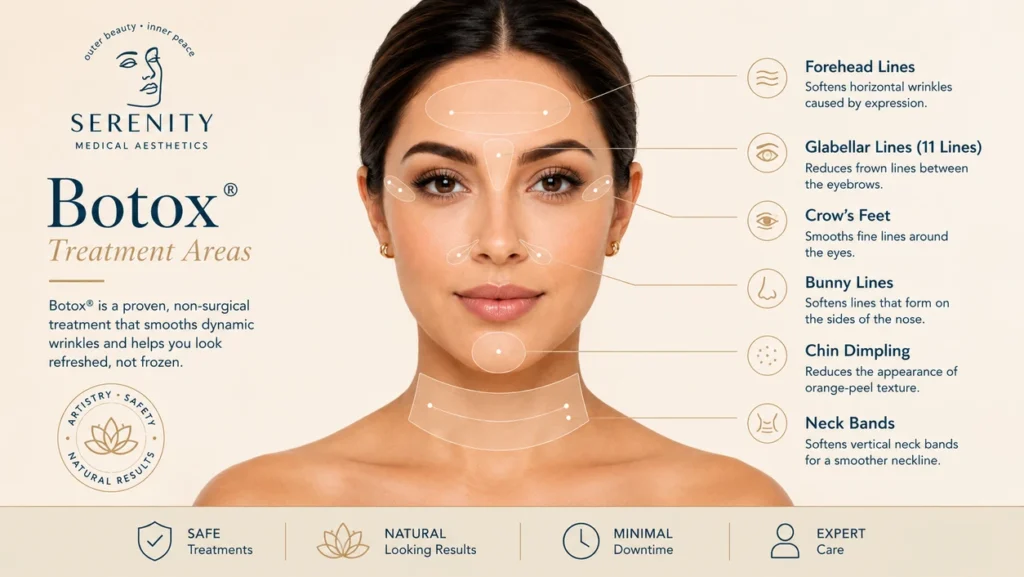
Botox handles dynamic wrinkles. The ones that only show up when your face actually moves. Frown, and you’ll see it show up right in the glabella. Raise your eyebrows in surprise, and there go the horizontal forehead lines. Squint into the sun, crow’s feet.
It blocks a signal called acetylcholine at the neuromuscular junction (real science, not a marketing term), and the muscle just stops firing as hard. You’ll see softening in three to seven days. Full effect lands around two weeks in. Then it lasts three to four months before your body clears it and the muscle wakes back up.
What it won’t touch: a wrinkle that’s still there when your face is dead still. Those are static wrinkles, built over years of collagen loss, and no amount of muscle freezing does a thing for them. Botox also does nothing, zero, for hollow cheeks or thin lips or that sunken look that comes with losing volume as you age. Ask an injector to use Botox for cheek volume and a good one will just say no.
What Do Fillers Fix That Botox Can’t Touch?
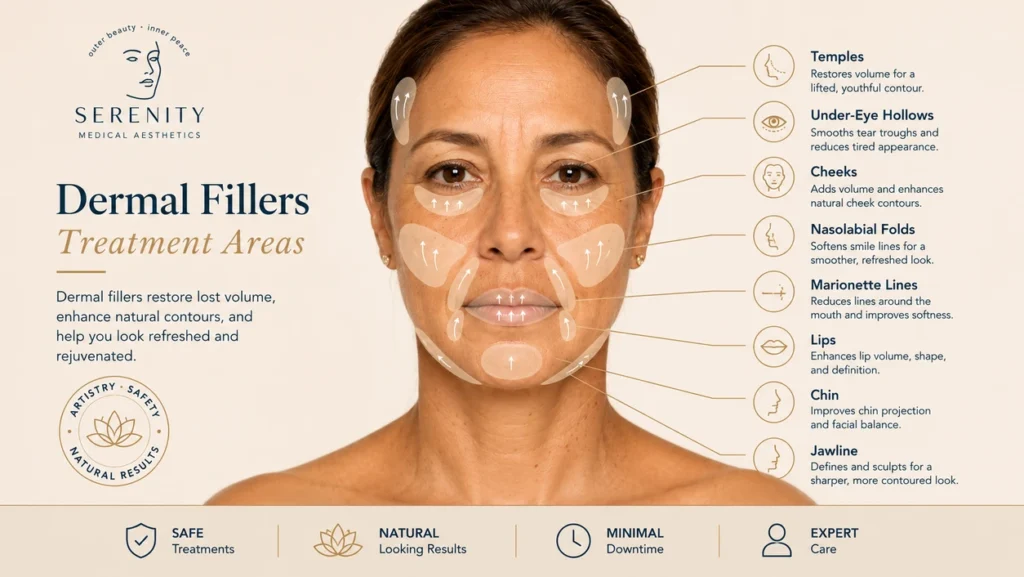
Fillers add volume, delivered by syringe. Hyaluronic acid, the most common base, is a sugar molecule your body already makes on its own, and it can hold something like a thousand times its weight in water. Apply FDA-approved dermal fillers right, and you get lift, structure, and hydration in one shot.
Flattened cheeks? Filler restores the contour. Lips that thinned out since your twenties? Filler brings the definition back. Nasolabial folds, those creases running from your nose down to the corners of your mouth, soften almost the moment volume fills the space beneath them. Under eye hollows are trickier. They respond well, but using too much filler can create an unnatural appearance.
And the results show up the same day. Not next week. Not gradually over a month like a collagen stimulator would build. You walk out of the appointment already looking different, which is exactly why some first timers get a little overenthusiastic with the syringe before they’ve learned restraint.
Duration is all over the map depending on product and placement. Lips burn through filler fast because they never stop moving. Cheeks barely move, so they hold structure well past a year sometimes. Call it six to eighteen months on average, and don’t trust anyone who gives you a tighter number with total confidence. Everybody metabolizes this stuff differently.
A Quick Word on the Different Filler Types
Not all fillers act the same and lumping them together does you no favors. Hyaluronic acid fillers like Juvéderm and Restylane are reversible. A provider can dissolve them if something looks wrong, which is a huge part of why they’re the default choice for anyone new to injectables.
Biostimulatory fillers play a completely different game. Sculptra and Radiesse don’t just sit there taking up space. They provoke your own collagen production over time, so the results build slowly and tend to outlast the HA options by a wide margin. Comparing those two head to head is genuinely its own conversation, worth reading up on before you commit to either one.
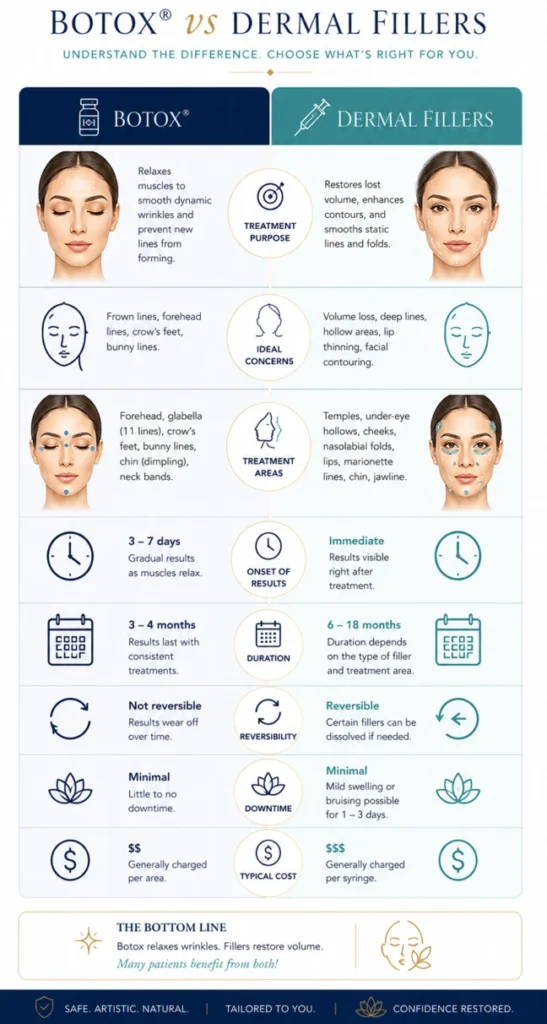
Botox vs. Fillers: The Side by Side Nobody Shows You
Numbers beat adjectives every time. Here’s the breakdown, no sales pitch attached.
Botox vs. Fillers: How Much Should You Expect to Pay?
Real numbers first, because vague pricing is exactly how clinics lure you in and then hand you a bill that has nothing to do with the botox vs fillers consultation you sat through.
Botox runs per unit, usually 10 – 20 dollars, and your total depends entirely on how much area you’re treating. Forehead alone might be 10 – 20 units. Add crow’s feet and the glabella and you’re at 40 – 60 units per session pretty fast. Do that math and a full upper face treatment lands somewhere between 400 – 800 dollars a visit. Three or four times a year. Every year.
Fillers get priced per syringe, typically 600 – 900 dollars depending on brand and your region. Lips might only need half a syringe for subtle definition. Cheeks usually need 1 – 2 full syringes if you’re after real structural change. Go bigger, cheeks plus nasolabial folds plus a little lip work, and you’re looking at 1,500 – 2,500 dollars in a single sitting.
Here’s what never makes it into the brochure. Botox is basically a subscription. You’re paying for it three or four times a year, indefinitely, if you want the effect to hold. Fillers behave more like a periodic investment since a carefully placed syringe of cheek filler might not need a touch up for over a year. Run the real annual math on both and Botox often ends up costing more over time, even though each individual visit looks cheaper on paper.
And worse still? Plenty of “discount” Botox deals are running diluted products, or worse, an inexperienced injector working off whatever training video they watched last month. Cheap Botox is rarely just Botox at a lower price. It’s usually a compromise you don’t discover until the results look wrong. Or uneven. Or both.
Which One Fixes Your Specific Problem?
Stop asking which treatment is “better.” Better for what, exactly? A hammer isn’t better than a screwdriver. It just does a different job, and grabbing the wrong one strips the screw every time.
Match the tool to the actual problem:
- Forehead lines, frown lines, crow’s feet that only show up when you move → Botox.
- Hollow cheeks, thin lips, deep nasolabial folds, sunken under eyes → Filler.
- A face that looks tired even after a full night of sleep → Usually both, together.
- Prevention in your late twenties or early thirties → Small doses of Botox, before the lines set in permanently.
Can You Get Both at the Same Appointment?
Yes. And for many faces, that combination is the right call from day one. Most providers still start with Botox alone though, letting it settle for two weeks before deciding whether filler is even needed in the amount originally planned.
Why the wait? Because Botox can quietly shift how a face holds itself once the muscles relax, sometimes softening the appearance of volume loss enough that less filler ends up being necessary. Book both on day one without that buffer and you risk overcorrecting. Paying for volume you never actually needed.
That said, many experienced injectors will comfortably combine both in one visit once a patient has a treatment history and a predictable response. It’s not a hard rule. It’s a judgment call your provider should be making alongside you, not for you.
What’s Actually Risky Here, and What’s Just Internet Fear Mongering?
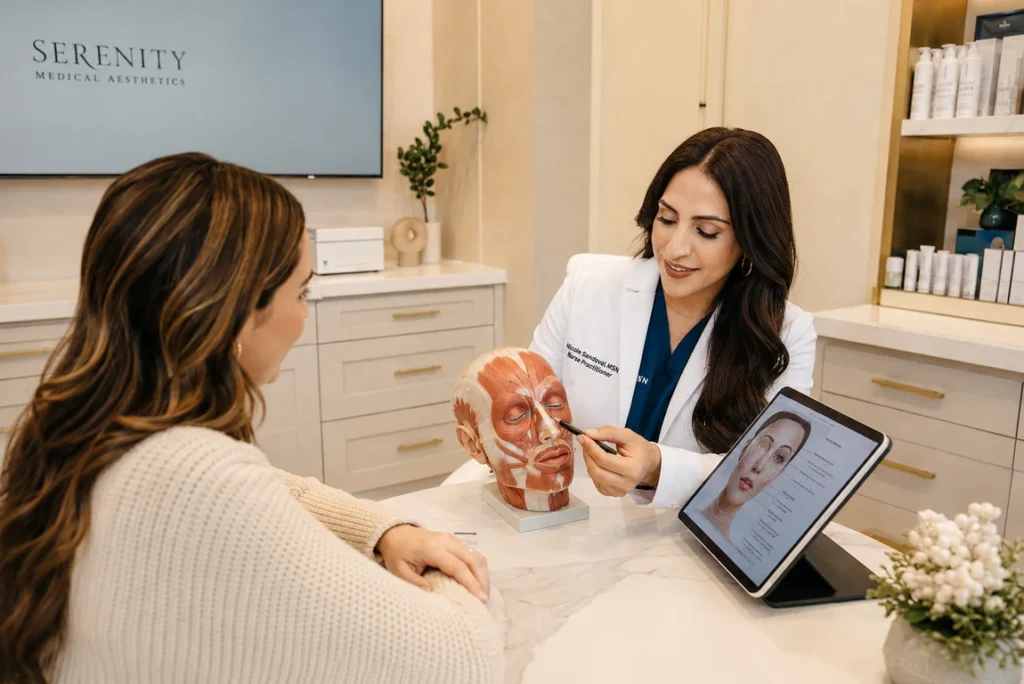
Every injectable carries some risk. Pretending otherwise helps nobody, and any provider who claims zero risk either hasn’t been doing this long enough to see a complication or isn’t being honest with you.
Botox: mild bruising at the site, the occasional headache, and, if the placement is off, a drooping eyelid or brow that can take weeks to fully resolve. Rare. Real, though. That “frozen” look everyone’s afraid of almost always traces back to overdosing or bad placement. Not the product failing on its own.
Fillers carry a heavier risk profile. Bruising and swelling are expected, temporary, and honestly not worth worrying about. Vascular occlusion, where filler compresses or enters a blood vessel, is the one that’s actually serious, though it stays rare in the hands of an experienced injector. Migration, where filler drifts from where it was placed, shows up more with certain products and techniques than others.
Here’s the part that actually matters, and it has nothing to do with brand names. Outcomes track far more closely with injector skill and anatomical knowledge than with whatever product happens to be in the syringe. A board certified nurse injector or physician who truly understands facial anatomy will beat a bargain provider using a premium product. Every time. Not most of the time. Every time.
Stop Guessing and Get an Actual Plan for Your Face!

You don’t need to pick a side between Botox and fillers before you even know which one your face needs. That call belongs in a real consultation, with someone who looks at your specific lines and your specific volume loss and tells you the truth instead of upselling whatever pays best that month.
Every plan at Serenity Medical Aesthetics is built around an honest assessment first and a product second. Book your consultation today and find out what would actually move the needle for your face. Not someone else’s.
Frequently Asked Questions
How long does Botox last compared to fillers?
Botox lasts three to four months. Fillers last six to eighteen months depending on product and area. Neither one is permanent.
Can Botox and fillers be done in the same visit?
Yes, though many providers do Botox first and wait two weeks before adding filler, so the dosing stays accurate.
Which hurts more, Botox or Fillers?
Fillers usually hurt more. Larger needles, denser gel. Most providers use numbing cream either way, so it’s manageable.
Do Botox and fillers cause permanent changes to your face?
No. Botox metabolizes on its own, and most fillers dissolve over time or get reversed with hyaluronidase if needed.
How do you know if you need Botox or filler first?
Get assessed by a professional. Movement lines mean Botox. Sunken or flattened areas mean filler. Guessing just wastes money.
MEDICAL DISCLAIMER: This article is written for educational and informational purposes only and does not constitute medical advice. Individual results vary. Always consult a qualified medical professional before pursuing any aesthetic or wellness treatment. Serenity Medical Aesthetics is a licensed medical practice in Pasadena, CA.

I am a dual board-certified Nurse Practitioner and the founder of Serenity Medical Aesthetics. With degrees from Stanford, Emory, and UCLA, and nearly a decade of clinical experience, I specialize in family medicine and aesthetic procedures. I also serve as a volunteer Assistant Clinical Professor at the UCLA School of Nursing. I write content on this website to ensure absolute clinical accuracy, safety, and alignment with the latest medical research.
You might also like to read



connect with us on instagram

Back to Top
Address
Phone
301 N Lake Avenue Suite 600 Pasadena CA 91101
hello@serenitymed.co
+1 818-971-9106
✨ Unlock $25 Off Your First Visit! ✨
Sign up to enjoy $25 off your first purchase of $250 or more and get access to exclusive promotions, wellness tips, and booking updates!
Share This Post